

Three Years, Nine Strike Days: Tinubu’s Reforms Are Delivering Results Across Nigeria.
By Babatunde KUYE
Politics often divides opinions. Some will support President Bola Ahmed Tinubu, while others will oppose him. That is the nature of democracy. However, beyond political sentiments, governance should ultimately be judged by measurable outcomes.
One area where the results are becoming increasingly evident is Nigeria’s tertiary education sector.
For more than two decades, public universities were trapped in a vicious cycle of recurring ASUU strikes. Academic calendars became unreliable, students spent years beyond their expected graduation dates, parents endured unnecessary financial burdens, and the country’s educational reputation suffered.
Successive administrations made efforts to resolve the crisis, but the problem persisted.
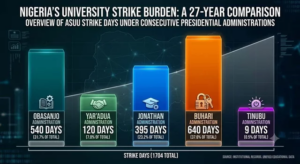
The available data paints a clear picture. Since Nigeria’s return to democratic rule in 1999, President Olusegun Obasanjo’s administration recorded about 540 strike days, President Umaru Musa Yar’Adua’s administration recorded 120 days, President Goodluck Jonathan’s administration recorded 395 days, while President Muhammadu Buhari’s administration witnessed the highest figure of 640 strike days.
President Bola Ahmed Tinubu inherited a university system where prolonged strikes had almost become a tradition. Yet, in nearly three years, his administration has recorded only nine strike days. For millions of students and their families, that represents a significant departure from the past.
Keeping universities open is not just an educational achievement; it is an economic and social one. Stable academic calendars enable students to graduate on schedule, reduce financial hardship on parents, improve workforce planning, and restore confidence in Nigeria’s public universities.
This progress did not happen in isolation. It is part of a broader reform agenda aimed at repositioning Nigeria’s economy and institutions. Across different sectors, the administration has embarked on reforms in the economy, infrastructure, energy, taxation, social investment, education, healthcare, agriculture, security, and local government administration. While some of these reforms have required difficult adjustments and continue to generate debate, they are intended to address long-standing structural challenges and lay a stronger foundation for sustainable growth.
No administration is without challenges, and much work remains to be done. The education sector still requires increased investment in infrastructure, research, staff welfare, and institutional capacity. However, preserving industrial peace while engaging stakeholders through dialogue is a notable shift from the frequent shutdowns that previously defined the sector.
As Nigerians continue to assess the performance of the current administration, it is important to recognize areas where tangible progress has been made. A government that is implementing reforms and producing measurable results deserves to be evaluated fairly and objectively.
Tinubu is working. Let us stay the course with a reform agenda that is beginning to yield results. One good turn deserves another. If these reforms are sustained and consolidated, Nigeria stands to benefit from stronger institutions, a more stable economy, and greater opportunities for future generations.
The journey of reform is rarely easy, but history has shown that nations that remain committed to difficult but necessary reforms are often the ones that achieve lasting prosperity.